 Español
 English


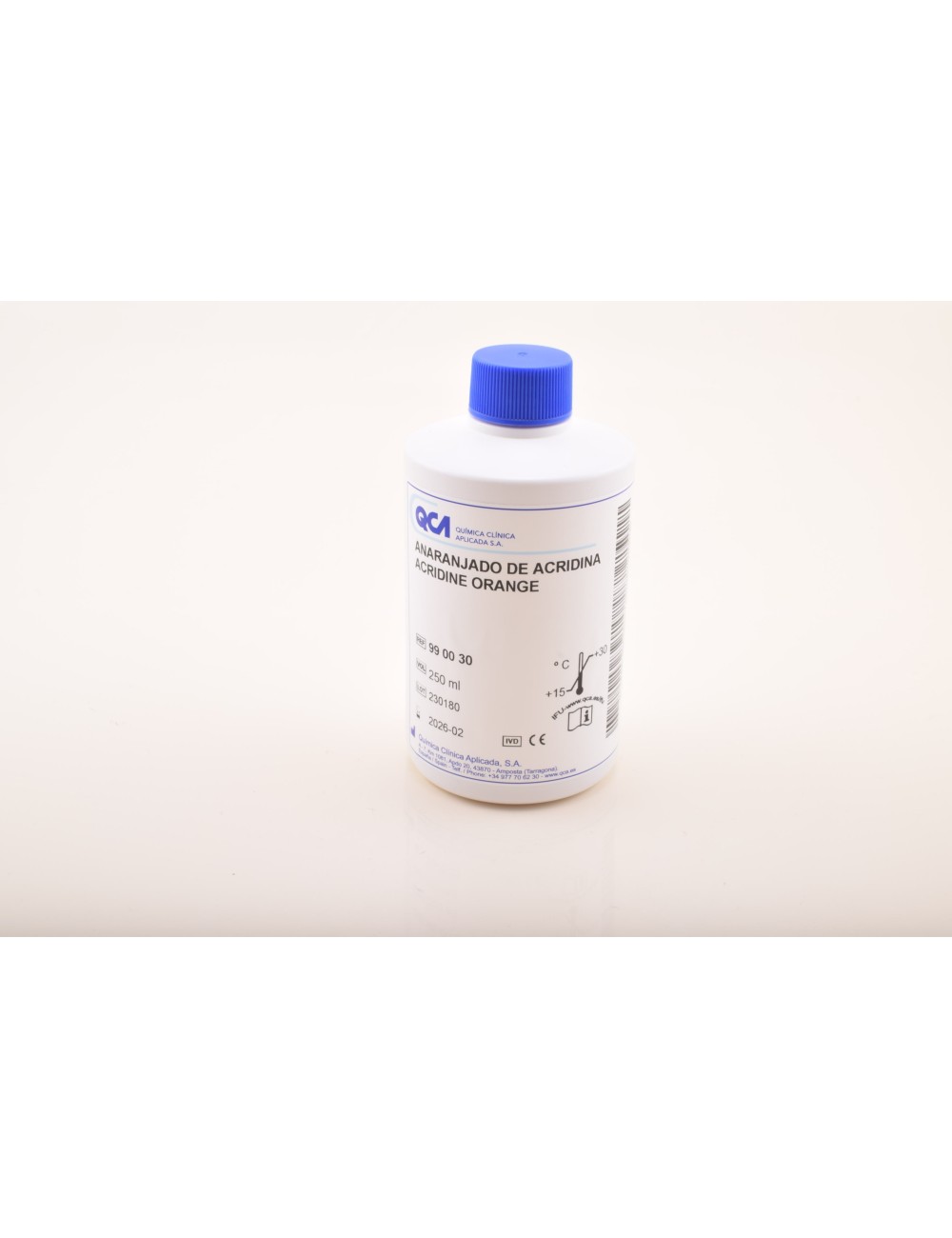
ACRIDINE ORANGE, 250 mL
990030
To access the documentation you must be registered Register


For in vitro diagnostics.
| State | Liquid |
| Storage temp. | +10 / +35 ºC |
| Technique | Fluorescent staining |
Documentation
 Download
Download
Download
Download
Download
Previous batches :
Download
PRINCIPLE
This fluorescent stain was described for the first time in 1942 by Strugger and Hilbrich, and has been widely used for the microbial examination of soil, water and food samples. It can also be used for staining microorganisms in non-fixed samples and for vital stains. It has also proven to be of great use in clinical samples, as it is a simple and quick staining procedure, which is more sensitive than the Gram stain in the detection of microorganisms.
Acridine Orange is used as a fluorescent dye to differentiate DNA and RNA. It binds to the nucleic acids of bacteria and other cells. When it is stimulated with ultraviolet light and the dye binds to DNA, the emission is at 525 nm (in the green). When it binds to RNA, the maximum emission is at 650 nm (in the red). This dye therefore stains cells in the active division phase (large quantity of DNA) green, and cells in interphase (large quantity of RNA and proteins) orange. Acridine orange has been used as a vital stain, giving off a green fluorescence if the microorganism is alive and a red fluorescence if it is dead.
Fluorescence staining provides the advantage of greater visibility of the fl uorescent microorganisms, which appear bright orange on a dark background, making it easier to work with lower magnification lenses, increasing the field of vision and reducing the time required to evaluate the preparation.
Staining with acridine orange also makes it possible to differentiate microorganisms from cell samples, if the dye is kept at a pH of between 3.5 and 4. The microorganisms are uniform and bright orange, while the inflammatory and epithelial cells, red blood cells and the rest of the background are pale green to yellow. The nuclei of the activated leukocytes, having a greater production of RNA due to activation, are yellow, orange or red.
For in vitro diagnostics.
| State | Liquid |
| Storage temp. | +10 / +35 ºC |
| Technique | Fluorescent staining |