 Español
 English


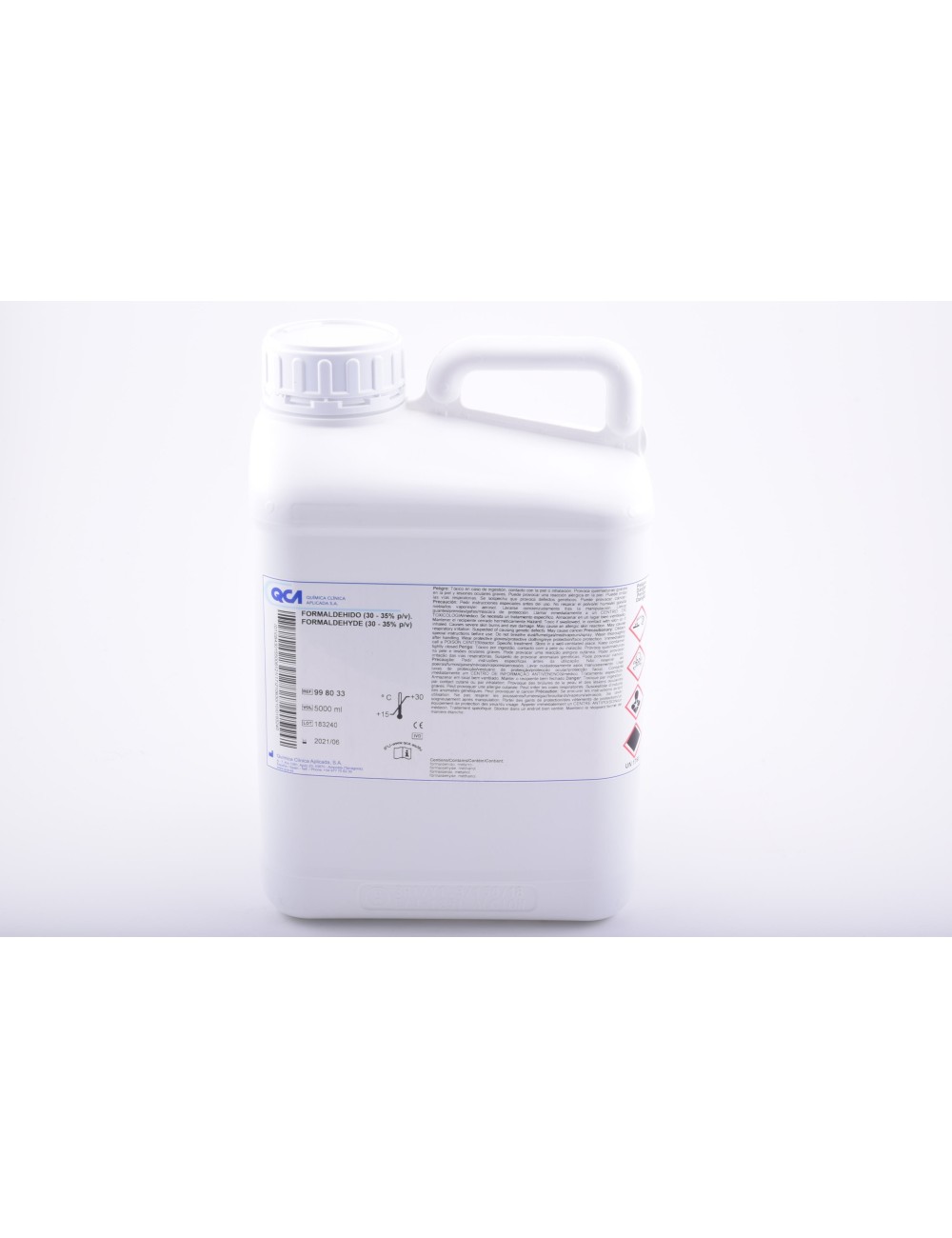
FORMALDEHYDE (FORMALIN) 30 - 35 %, 5000 mL
998033
To access the documentation you must be registered Register


For Histological and Histopathological Laboratories.
| State | Líquido |
| Storage temperature | +10 / +35 ºC |
Documentation
 Download
Download
Download
Download
Download
Previous batches :
Download
PRINCIPLE
Tissue fixation is mainly done by the immersion of the tissues into chemical agents (fixatives) in order to interrupt the degradation processes that occur after the cell death, and thus, it preserves the structures and composition of the tissue. Fixing agents have the ability to stop the enzyme activity, the process of tissue autolysis and protein denaturation. Some fixatives can be used, likewise, as a preservative, but not in all cases can be ensured a long term preservation. Fixation is not synonymous with tissue preservation. Fixation types: The fixation processes can be classifi ed in two kinds depending on the results obtained in regards the tissue structure and its biochemical composition.
1. Histological fixation: it basically preserves the tissue structures, regardless if it produces or not biochemical changes.
2. Histochemical fixation: it’s intended to preserve the maximum possible the molecular composition.
It must be noted that it doesn’t exist a multi - purpose fixation agent suitable for all tissues and assays. Each fixation agent is appropriate for certain types of tissues and techniques and they can’t provide suitable results with another tissues and assays. Each particular assay requires a diff erent fixation agent.
For Histological and Histopathological Laboratories.
| State | Líquido |
| Storage temperature | +10 / +35 ºC |