 Español
 English


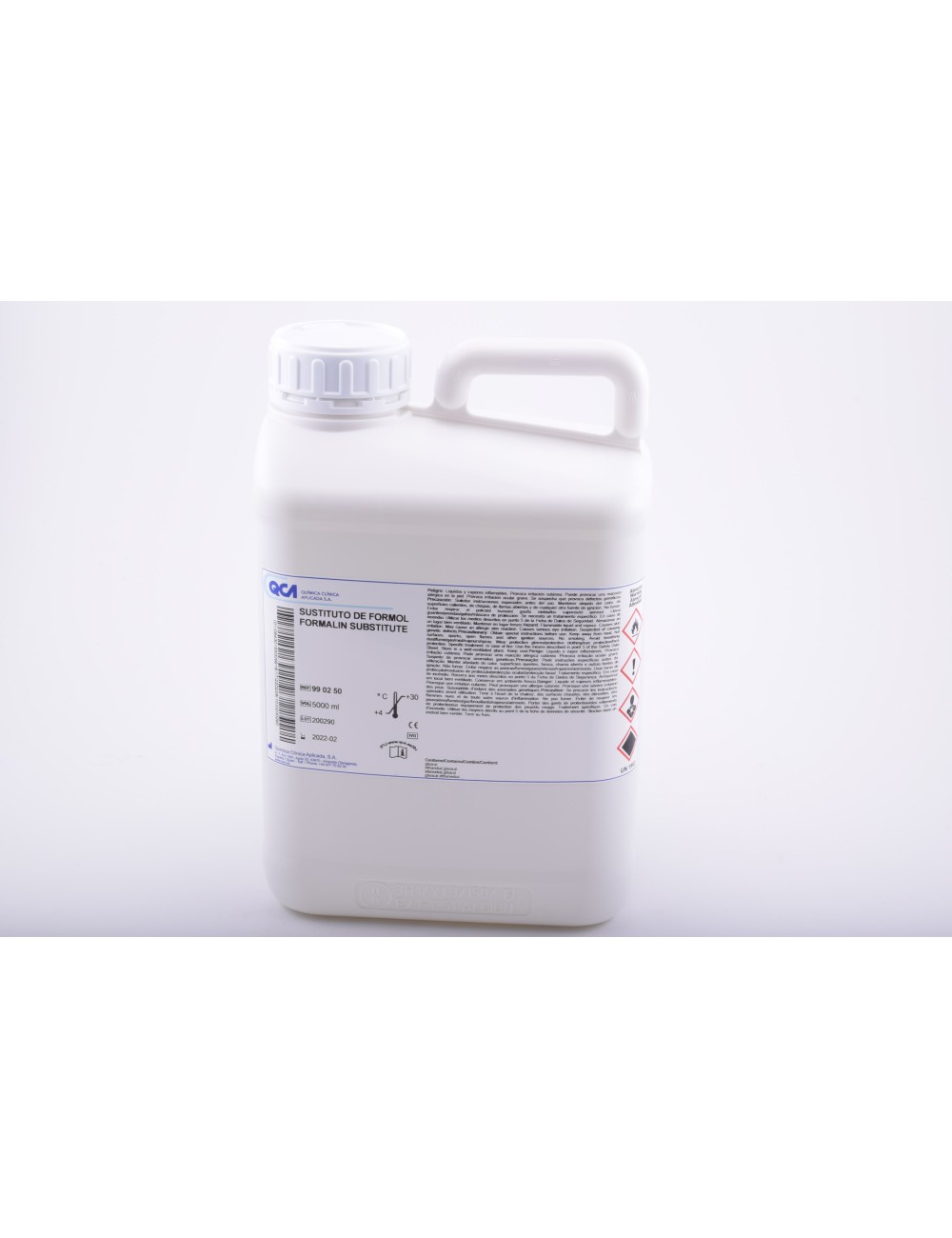
FORMALIN SUBSTITUTE, 5000 mL
990250
To access the documentation you must be registered Register


For Histological and Histopathological Laboratories
| State | Liquid |
| Tª Conservation | +4 / +35 ºC |
Documentation
 Download
Download
Download
Download
Download
Previous batches :
Download
PRINCIPLE
Tissue fixation by chemical methods aims to interrupt the degradation processes that occur after cell death, to preserve the structure and composition of the tissues as much as possible. Fixative agents have the ability to stop the autolysis process of tissues, denature proteins and inactivate enzymatic activity. Some fixatives can also act as preservatives, but not in all cases indefinite conservation can be guaranteed. Fixation is not synonymous with tissue conservation. Types of fixation: Depending on the type of test and the staining to be performed, two procedures are distinguished.
1. Histological fixation: basically preserves the structure, without taking into account whether or not an alteration occurs in the biochemical components.
2. Histochemical fixation: aimed at preserving the molecular composition as much as possible. It is worth keeping in mind that a certain fixing agent may be suitable for certain types of fabrics but not offer ideal results with others. Therefore, there is no universal fixator that is optimal for all work situations. The ideal product must be used depending on the type of process, fabric and study for each particular situation.
For Histological and Histopathological Laboratories
| State | Liquid |
| Tª Conservation | +4 / +35 ºC |