 Español
 English


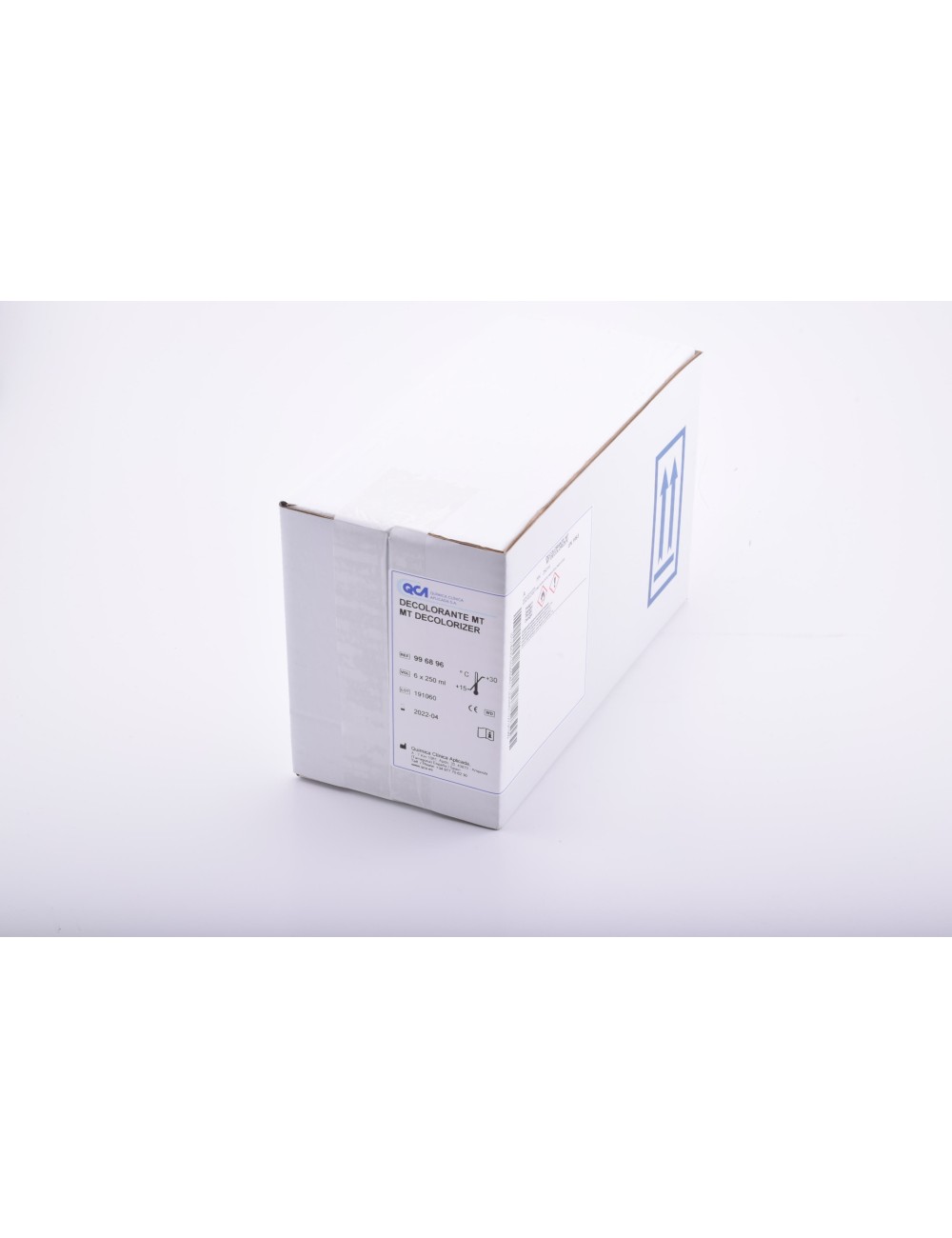
MT DECOLORIZER, 6 x 250 mL
996896
To access the documentation you must be registered Register


Reagent Nr. 2 for Auramine (Morse) and Auramine-Rhodamine.
| State | Liquid |
| Storage temp. | +15 / +30 ºC |
| Technique | Fluorescent staining |
Documentation
 Download
Download
Download
Download
Download
Previous batches :
Download
PRINCIPLE
Mycobacteria are acid-fast microorganisms that have a special lipid cell wall, which contains mycolic acid, amongst other substances. This enables the wall to resist destaining with acid-alcohol after staining with basic dyes such as fuchsin. The cell wall appears a reddish-pink colour, while the remainder of the microorganism is stained with the counterstain, normally Methylene Blue. The technique for detecting acid-fast microorganisms by fluorescence is similar to the Ziehl classic staining method. The fenicade fuchsine is replaced by a fluorescent dye with added phenol - in this case auramine, according to the Morse technique. The auramine binds to the mycolic acids of the wall and the free dye is removed by rinsing with the acidic destaining agent. The counterstain, potassium permanganate or thiazine red, removes the non-specific background fluorescence.
Compared to the classic staining methods, fluorescence staining provides the advantage of greater visibility of the fluorescent microorganisms on a dark background, making it easier to work with lower magnification lenses, increasing the field of vision and reducing the time required to evaluate the preparation.
INTENDED USE
Family of in vitro diagnostic medical devices intended for detection of acid-fast bacteria, such as the Mycobacteria and Nocardia species and the cysts of Cryptosporidium and Isospora using the fluorescent auramina-rodamina Truant method.
They are qualitative stains that provide information on the physiological or pathological state of the tissue sample when the staining obtained is interpreted by a trained professional. To obtain a diagnosis, the result is utilized alongside other information such as the patient’s medical history, physical status as well as other clinical and laboratory data obtained.
For trained and specialized personnel
Reagent Nr. 2 for Auramine (Morse) and Auramine-Rhodamine.
| State | Liquid |
| Storage temp. | +15 / +30 ºC |
| Technique | Fluorescent staining |