 Español
 English


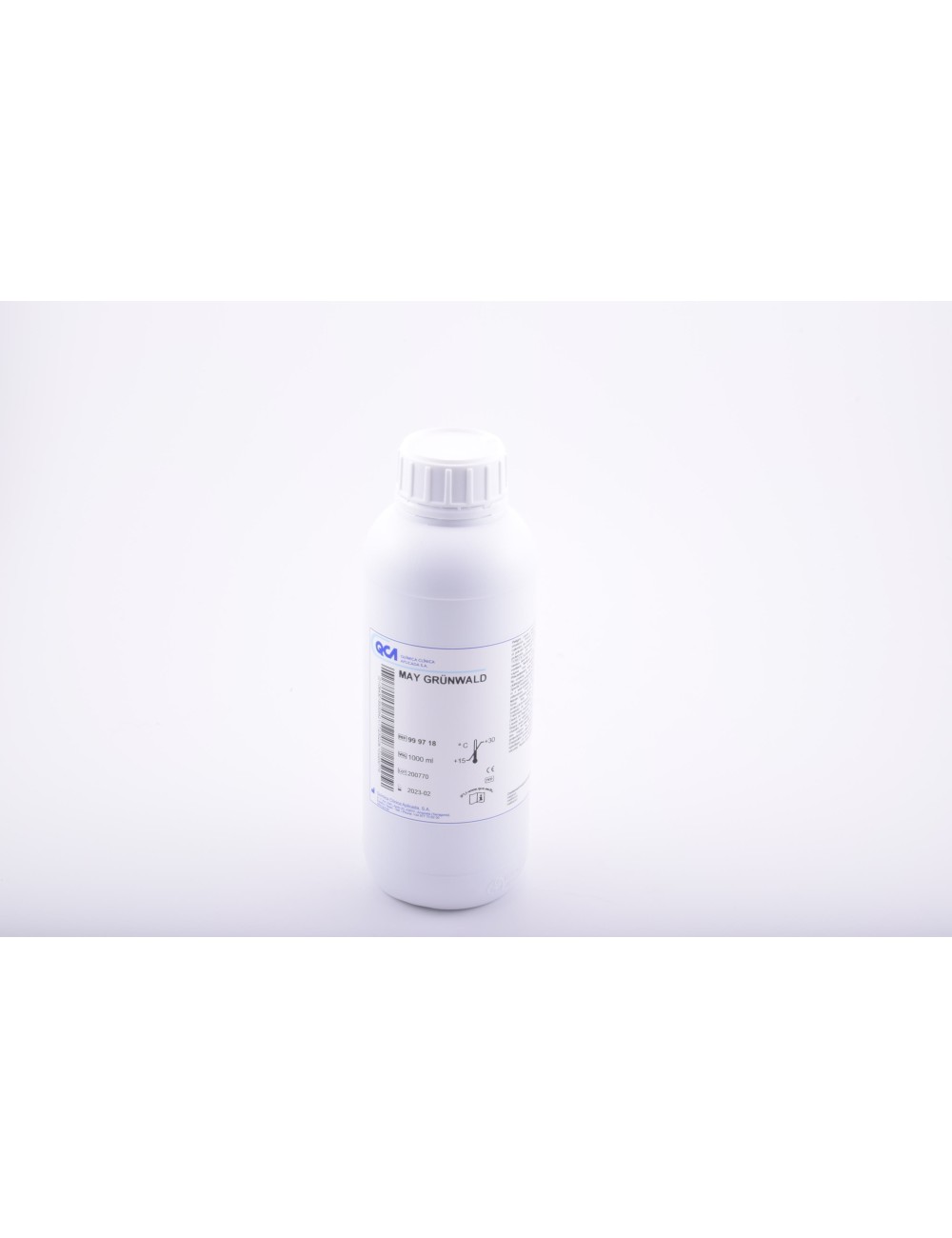
MAY GRÜNWALD, 1000 mL
999718
To access the documentation you must be registered Register


For in vitro diagnostic.
| State | Liquid |
| Storage temp. | +15 / +30 ºC |
| Technique | Romanowsky differential staining |
Documentation
 Download
Download
Download
Download
Download
Previous batches :
Download
PRINCIPLE
The May-Grünwald stain belongs to the Romanowsky group of stains. Romanowsky stains consist of Methylene Blue and its oxidised derivatives, basic dyes and the acidic dye, Eosin. Basic dyes bind to the acidic components of cells, nucleic acids, granules in neutrophils and acidic proteins which are stained a relatively deep red-purple colour, while eosin binds to haemoglobin, basic components of cell structures and eosinophil granules. The balance between Methylene Blue and its oxidised derivatives, and between these and Eosin, provides an essentially blue shade and a greater or lesser staining intensity, which are characteristics of each type of stain - Giemsa, May-Grünwald or Wright. This stain may be used alone or combined with the Giemsa stain. Its use allows the differential staining of blood cells. Some authors use the May-Grünwald stain or the May-Grünwald-Giemsa combination for the staining of parasites in blood. The result of the staining may be infl uenced by several factors, such as the fi xation, the staining time and the pH value of the staining solution and the buffer solution. If the pH is too basic the staining will be more blue, and if the pH is too acidic, the staining will be more pink.
DIAGNOSTIC USE
For the differential staining of peripheral blood and bone marrow smears.
For in vitro diagnostic.
| State | Liquid |
| Storage temp. | +15 / +30 ºC |
| Technique | Romanowsky differential staining |