 Español
 English


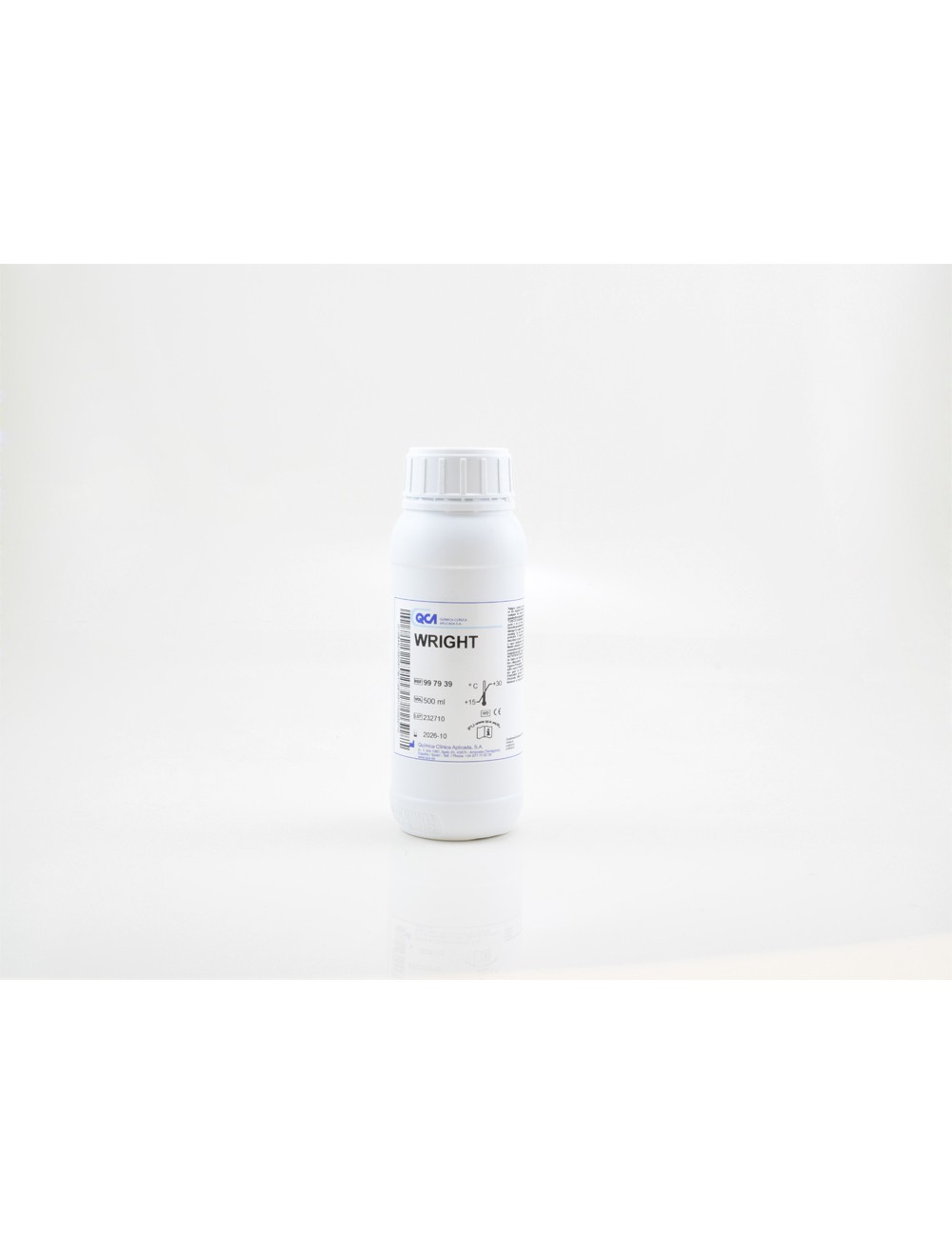
WRIGHT, 500 mL
997939
To access the documentation you must be registered Register


For in vitro diagnostic.
| State | Liquid |
| Storage temp. | +15 / +30 ºC |
| Technique | Modified Romanowsky staining |
Documentation
 Download
Download
Download
Download
Download
Previous batches :
Download
PRINCIPLE
The Wright’s stain belongs to the Romanowsky group of stains. It is named after the scientist who developed it, James Homer Wright. He created it in 1902 by modifying the Romanowsky stain. Romanowsky stains consist of methylene blue and its oxidised derivatives, basic dyes and the acidic dye, eosin. Basic dyes bind to the acidic components of cells, nucleic acids, granules in neutrophils and acidic proteins which are stained a relatively deep red-purple colour, while eosin binds to haemoglobin, basic components of cell structures and eosinophil granules.
The balance between methylene blue and its oxidised derivatives, and between these and eosin, provides an essentially blue shade and a greater or lesser staining intensity, which are characteristics of each type of stain - Giemsa, May-Grünwald or Wright.
Its use allows the differential staining of blood cells.
For in vitro diagnostic.
| State | Liquid |
| Storage temp. | +15 / +30 ºC |
| Technique | Modified Romanowsky staining |