 Español
 English


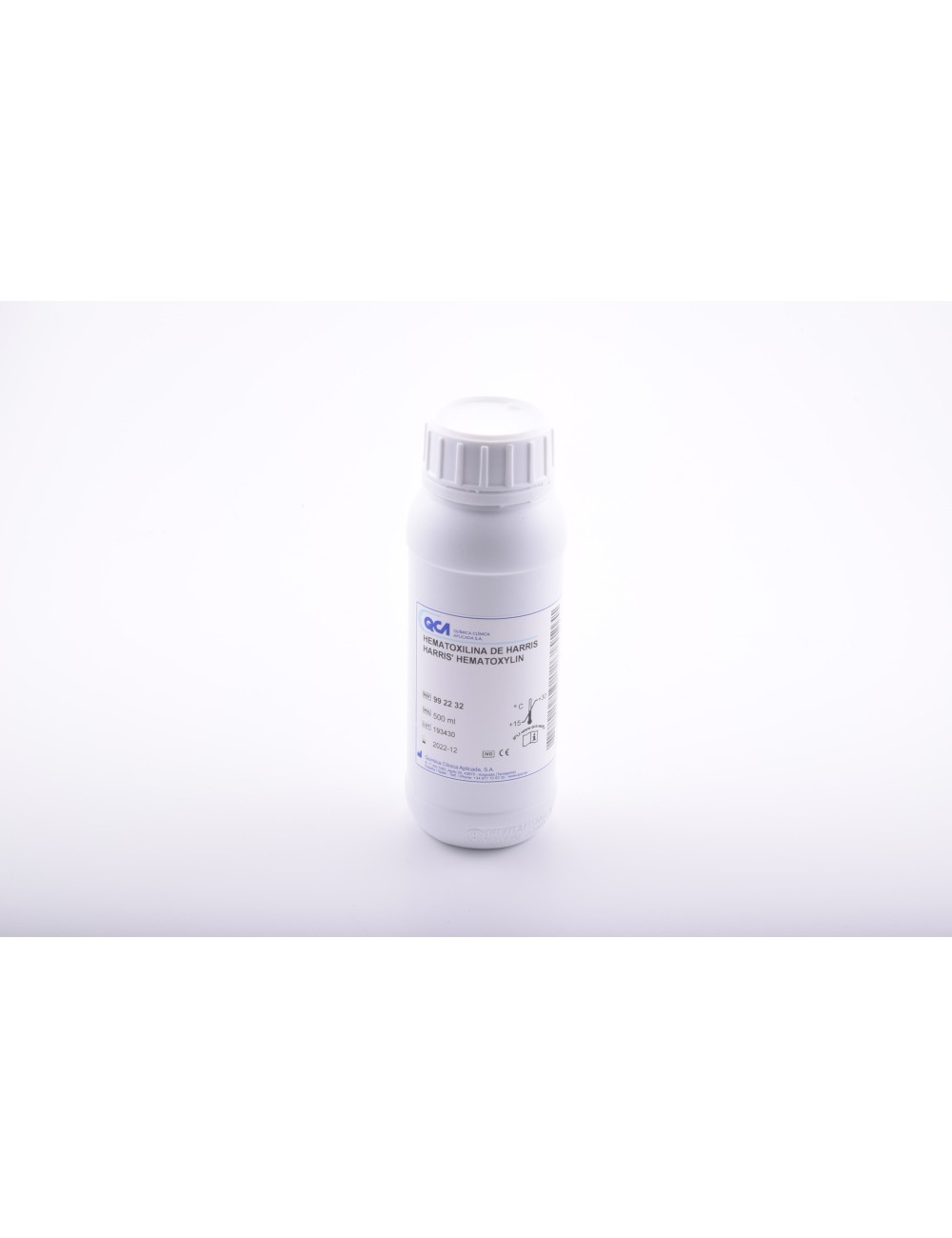
HARRIS' HEMATOXYLIN, 500 mL
992232
To access the documentation you must be registered Register


Nuclear staining.
| State | Liquid |
| Tª Conservation | +10 / +35 ºC |
| Technique | Papanicolaou Stain or Hematoxylin-Eosin Stain |
Documentation
 Download
Download
Download
Download
Download
Previous batches :
Download
PRINCIPLE
It allows detecting changes in cells that may be precursors of cancer. In this technique, the first step is the staining of nuclei, with hematoxylins. The second step is staining the cytoplasm with an orange solution, which stains the mature and keratinized cells with different intensity. In the third staining step, the so-called polychrome solution is used, which is a mixture of eosin, SF light green and Bismarck brown. With the polychrome solution, the differentiation of the simple squamous epithelium is shown. Hematoxylin-Eosin staining is the most used in histology.
Hematoxylin dyes are basically formed by metallic lakes of hematoxylin oxidized with divalent or trivalent ions. The staining mechanism is carried out through covalent unions of the metal-hematoxylin complex with anionic radicals of the tissue. In the case of nuclear material, the anionic groups of the phosphoric acid of the DNA would intervene in the reaction. The selectivity of the stain increases with the acidic medium of the dye, since it makes it difficult to color elements of an amphoteric nature, such as the amino acids of proteins. The nuclei appear blue to dark violet.
With hematoxylin, progressive and regressive staining can be performed. In regressive staining, the nuclear structures appear more differentiated and can be seen better.
Nuclear staining.
| State | Liquid |
| Tª Conservation | +10 / +35 ºC |
| Technique | Papanicolaou Stain or Hematoxylin-Eosin Stain |