 Español
 English


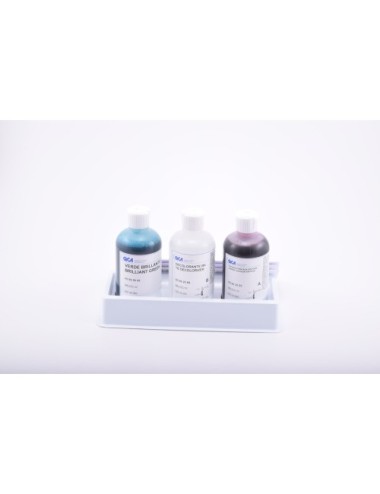

TB KINYOUN KIT, 3 x 250 mL
992505
To access the documentation you must be registered Register


For in vitro diagnostic.
| State | Liquid |
| Tª Conservation | +15 / +30 ºC |
| Technique |
Documentation
 Download
Download
Download
Download
Download
Previous batches :
Download
PRINCIPLE
Kinyoun staining is a variant of the classic Ziehl-Neelsen staining procedure which uses basic fuchsine with high concentrations of phenol as its primary stain. This allows cold staining, whereas the classic Ziehl-Neelsen staining procedure specifi es the use of heat in the primary staining phase. The remaining phases in the procedure are the same as those in the original Ziehl method. Brilliant Green is used as a counterstain, although Methylene Blue may also be used. ZiehlNeelsen staining is used to differentiate acid-fast microorganisms. These microorganisms have a special lipid cell wall, which contains mycolic acid, amongst other substances. This enables the wall to resist destaining with acid-alcohol after staining with basic dyes such as fuchsine. The cell wall appears a reddish-pink colour, while the remainder of the microorganisms are stained with the counterstain. It is assumed that permeability through intact membranes may be an important component of the mechanism involved in the phenomenon of resistance to destaining by the acid-alcohol solution indicated above. Although the mechanism of differentiation is not fully established, the method is fully accepted as a procedure for early diagnosis, as well as to provide information on the number of bacilli present in the sample. Acid-fast microorganisms are basically mycobacteria, although there are other microorganisms which also present this characteristic, such as the genus Nocardia and some parasites, such as Cryptosporidium.
DIAGNOSTIC USE
Stains for Kinyoun staining are used to perform the staining of cultures or samples which are suspected of containing mycobacteria, for early diagnosis of mycobacterial infection and its characterisation.
For in vitro diagnostic.
| State | Liquid |
| Tª Conservation | +15 / +30 ºC |
| Technique |