 Español
 English


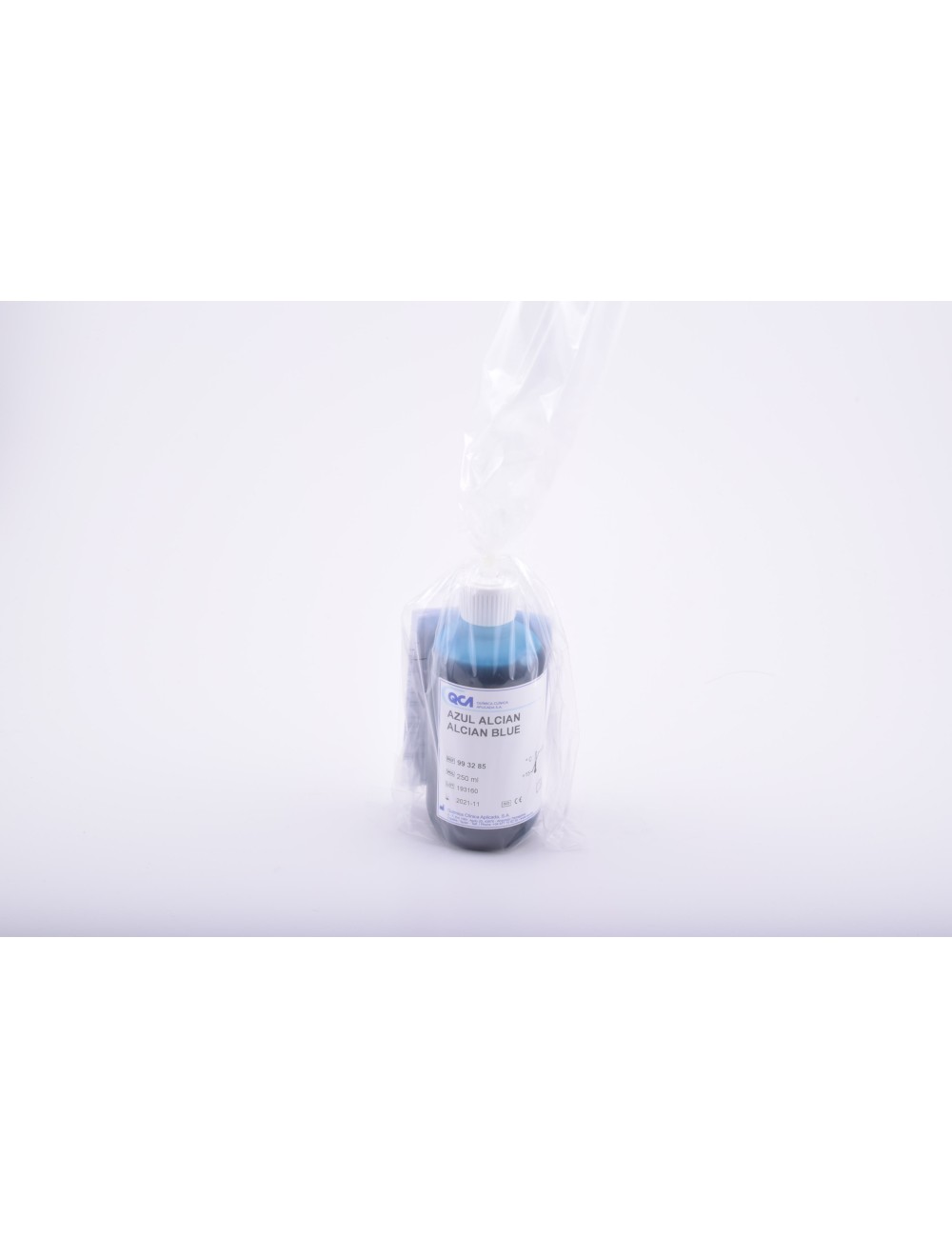
ALCIAN BLUE, 250 mL
993285
To access the documentation you must be registered Register


For in vitro diagnostic.
| State | Liquid |
| Storage temp. | +15 / +30 ºC |
| Technique | PAS staining |
Documentation
 Download
Download
Download
Download
Download
Previous batches :
Download
PRINCIPLE
Alcian blue is a basic stain composed of a series of tetramethyl-thiouronium isomers. It was synthesised for the first time in the 1940s for industrial use, and in 1950 Steedman used it for the first time as a selective stain for mucins. It is used mainly to detect carbohydrates in histochemical processes in animal tissues, and for the staining of primary cell walls in plants. The blue colour is due to copper in the molecule.
Acid mucopolysaccharides are polysaccharides which do not have alcoholic groups in the 1,2 glycol position, but instead have carboxylic or sulphuric acid groups. It has been proven that alcian blue stains sulphated and carboxylated acid mucopolysaccharides in pH conditions of approximately 2.4 to 2.6. At a very low pH, of approximately 1, only the sulphated mucopolysaccharides are stained. The carboxylated mucopolysaccharides do not stain. The staining selectivity increases if the pH is reduced to 0.5, when only the strongly sulphated mucopolysaccharides are stained.
The mucin in a tumour can be used to assess its malignancy. Carcinomas derived from epithelial tissue generally contain mucins, while melanomas, lymphomas and sarcomas rarely contain high levels of these. The detection of sulfomucins in gastric mucosa may help in the detection and characterisation of intestinal metaplasia, a lesion associated with gastric cancer.
For in vitro diagnostic.
| State | Liquid |
| Storage temp. | +15 / +30 ºC |
| Technique | PAS staining |